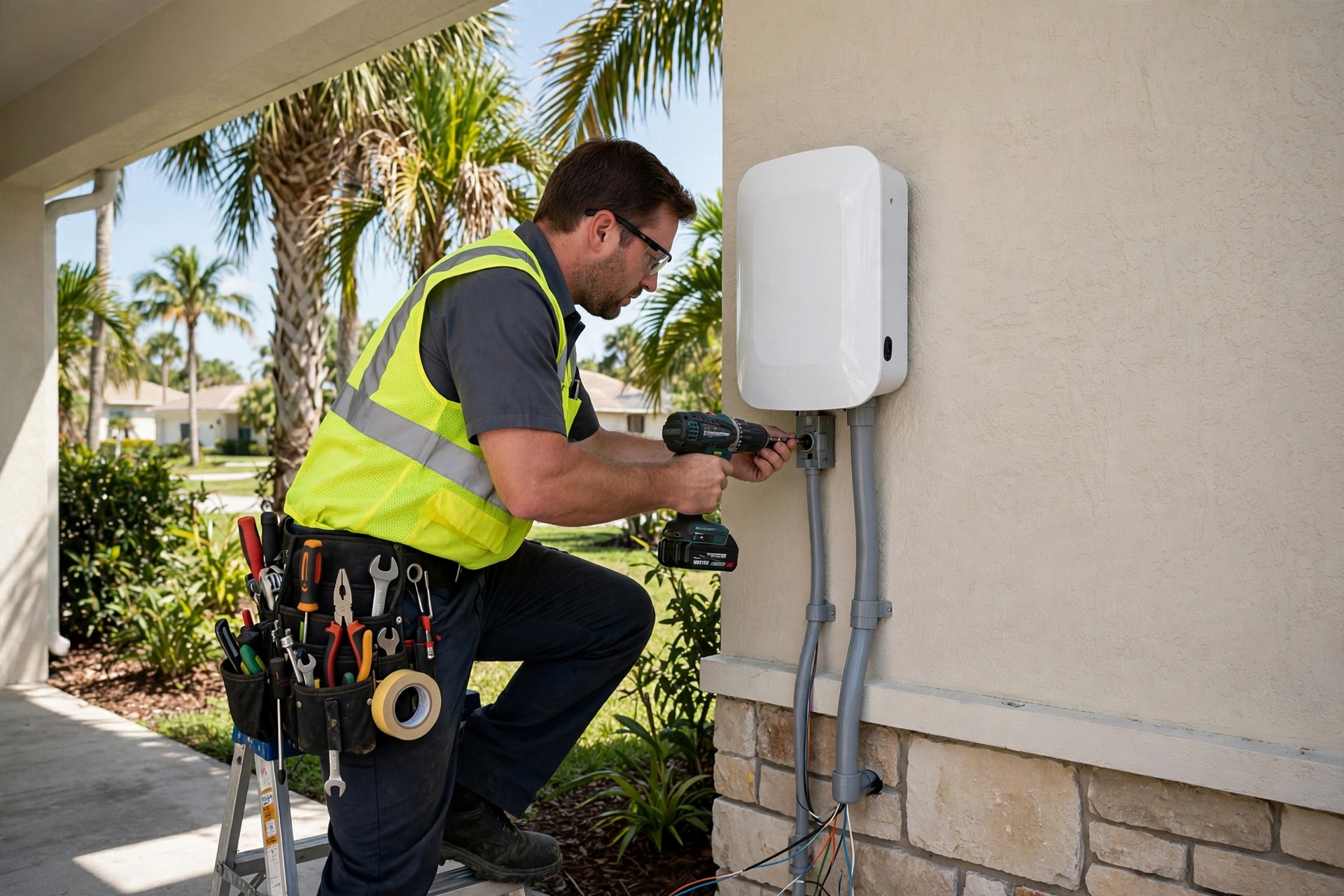
Port Saint Lucie homes in neighborhoods like Tradition and St. Lucie West often feature 200-amp panels installed during the 2000s housing boom, but many still lack the dedicated circuits needed for Level 2 chargers. Electricians must account for the county's requirement for permits and inspections under the Florida Building Code, which incorporates NEC Article 625 for EV supply equipment. Outdoor units demand NEMA 4X enclosures to handle salt air from nearby coastal influences and frequent afternoon thunderstorms that can cause rapid corrosion on standard hardware.
Hot humid summers accelerate heat buildup in garage-mounted chargers, so proper ventilation and derating calculations become essential when running 6-gauge copper from the main panel to the charging location. In River Park and White City, older slab-on-grade homes may have limited attic access for conduit runs, forcing exterior trenching that requires moisture barriers against the area's high water table. Skipping a load calculation risks tripping breakers during peak summer AC use combined with charging.
Mild winters reduce some thermal stress but increase the chance of surge damage from tropical storms, making whole-house surge protection a common add-on during installs. Technicians verify grounding continuity at the service entrance before energizing any charger to meet St. Lucie County inspection standards. Homeowners in St. Lucie West frequently request integration with existing smart panels to manage time-of-use rates from local utilities.
Technician insight
In Port Saint Lucie the thing that catches most people out with EV Charger Installation is the high water table in River Park and White City forcing exterior conduit to be run in sealed PVC with proper drainage rather than trying to fish through slab foundations.
Tradition Home Charger Install
A homeowner in Tradition needed a 48-amp charger but the 200-amp panel was already near capacity from AC units. We performed a load calculation, added a subpanel, and ran exterior conduit rated for humidity and storm exposure. The installation passed county inspection on the first try and the owner now charges without breaker trips during summer peaks.
EV Charger Installation Services We Offer
✓Level 2 Residential Charger Installation
Hardwired 240-volt units up to 60 amps sized for daily commuting needs in Tradition and St. Lucie West homes.
✓Outdoor Weatherproof EV Charger Setup
NEMA 4X rated stations mounted on exterior walls or posts with conduit rated for Port Saint Lucie's humid and storm-prone conditions.
✓Panel Upgrade for EV Charging
Replacement or addition of subpanels and breakers to support charger loads without overloading 1980s-2000s era service equipment common in River Park.
✓EV Charger Circuit Extension
New dedicated runs from the main panel through attics or trenches to garage or driveway locations in White City properties.
✓Smart Charger Integration
Wi-Fi or app-controlled units tied to existing home automation for managing charging during off-peak hours in St. Lucie County.
EV Charger Installation Cost in Port Saint Lucie, FL
| Service | Typical Range | What Affects It |
|---|---|---|
| Level 2 Charger Circuit Only | $800–$1,400 | Varies with distance from panel and whether trenching is required in areas like River Park. |
| Full Outdoor Unit Install | $1,200–$2,000 | Includes weatherproof hardware and surge protection common for tropical storm exposure. |
| Panel Upgrade Add-On | $1,500–$3,000 | Needed when existing 200-amp service cannot support added load in older White City homes. |
Ranges are typical for Port Saint Lucie, FL and confirmed with an exact written quote before any work starts.
How it works
- 1
Site Assessment
Measure panel capacity, run distances, and exposure to weather at the property in neighborhoods such as Tradition or St. Lucie West.
- 2
Load Calculation
Verify available amperage against existing HVAC and appliance demands before selecting charger size and circuit rating.
- 3
Permit And Planning
Submit required documentation to St. Lucie County and coordinate any trenching or exterior routing needed for storm resistance.
- 4
Installation And Testing
Mount the unit, pull and terminate conductors, install GFCI protection, then energize and confirm operation with the homeowner.
Pricing
Most residential installs fall between $800 and $2,200 depending on panel capacity and run length.